
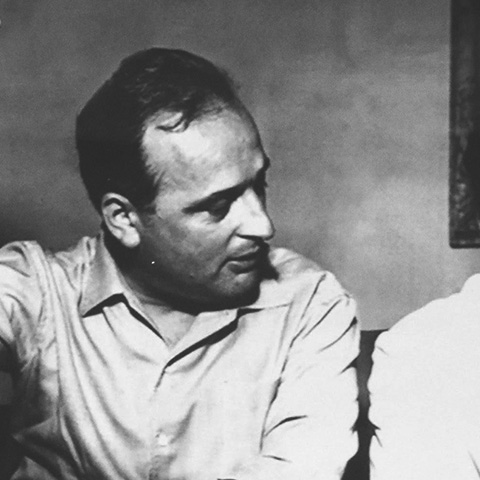
Mauro Bolognini was born in Pistoia on 28 June 1922, in the family home on via Dalmazia. He studied architecture and graduated in Florence before moving to the Centro Sperimentale di Cinematografia in Rome, where he attended set-design courses. After graduating he turned to directing, honing his craft as assistant to Luigi Zampa and later, in France, to Yves Allégret and Jean Delannoy. He began his directing career, making a name for himself between 1955 and 1958 with sketches of a late neorealism: Gli innamorati (1955), Giovani mariti (1957).
His encounter with Pasolini as screenwriter opened the way to greater ambitions with films such as La notte brava (1959), Il bell’Antonio (1960) and La giornata balorda (1960), even though his literary commitment too often faded into a calligraphic taste in Senilità (1962), Agostino (1962), Bubù (1971), Per le antiche scale (1975) and L’eredità Ferramonti (1976). He returned to the period atmosphere and painterly Tuscan mood of his film La viaccia (1961) in 1970 with Metello, where the historical and social structure of Pratolini’s novel allowed him a balanced and solid evocation: his finest.
Among his other films are: Imputazione di omicidio per uno studente (1972), Libera, amore mio! (1973), a film immediately withdrawn for political reasons, Fatti di gente perbene (1974), La storia vera della signora dalle camelie (1981), La venexiana (1986), Mosca addio (1987) and La villa del venerdì (1991).
From the early 1970s Bolognini also devoted himself to various opera productions, including Bellini’s Norma at the Teatro alla Scala in Milan (sets by Mario Ceroli, 1972) and the same opera at the Bolshoi Theatre in Moscow (1975), Puccini’s La fanciulla del West at the Rome Opera, Aida at the Teatro La Fenice in Venice (1978) conducted by Giuseppe Sinopoli (in his debut), and Hans Werner Henze’s Pollicino (1995) at the Teatro Poliziano in Montepulciano.