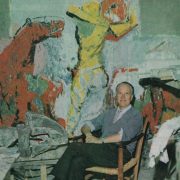

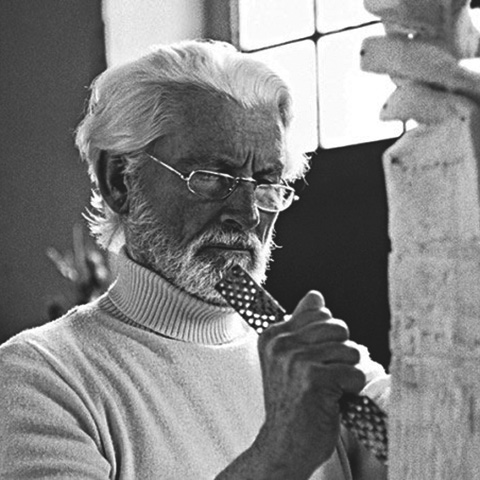
The son of a stonemason, from childhood he showed an interest in his father’s tools. He studied in Pistoia at the Scuola Artigiana and enrolled at the Art Institute of Florence. Called up for the war, he was on the Balkan front. On 8 September 1943 he was in Montenegro and was taken prisoner, interned in Bulgaria, Hungary, Austria and finally Germany. Although wounded, he escaped from captivity into France. He returned to Pistoia in 1946.
In 1949 he moved to Florence, where he completed his artistic training. To make a living he sold ceramics. In 1951 he found work at the Michelucci foundry in Pistoia, where he met the architect Giovanni Michelucci, with whom he would have an intense collaboration. From those years date the wooden Crucifix of the church of the Vergine in Pistoia and the one for Michelucci’s Church of the Motorway.
In 1955 Vivarelli met the American architect Oscar Gregory Stonorov at the exhibition on Frank Lloyd Wright at Palazzo Strozzi in Florence; they became friends and began to collaborate. Vivarelli worked in the United States, creating two large works in two squares of two American cities: Philadelphia and Detroit. He travelled to Michigan, to Black Lake, where he worked with the UAW Family Education Center.
From 1959 he taught regularly at the Petrocchi Art Institute in Pistoia. In 1963 he was part of the Intrarealist Group, which felt the need to express something new and to say it in a different way. On 9 July 1967 the group presented itself at Palazzo Strozzi in Florence, among others alongside Fellini, Finotti, Santachiara and Girardello. In 1970 he returned to Pistoia. On the hills around the city he had a house-studio built to a design by the architect Stonorov, a house that became his refuge.
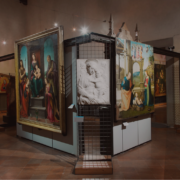
A distinctive feature of his work were also the retrospective exhibitions staged in archaeological or monumental settings, such as the famous one of 1975 at Trajan’s Markets in Rome.
His last work, “il senso degli opposti”, dates from 2006, for the competition for the “monument to the fallen of Nasiriyah”, in collaboration with the architect Oreste Ruggiero (Rome).
He died on 1 September 2008 in his villa in Pistoia at the age of 86, following bronchopulmonary complications.
One of his major works was the bronze “Christ the Redeemer” in the rectory church of Cristo Redentore in Monsummano Terme.