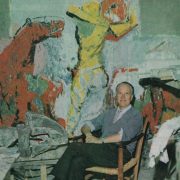

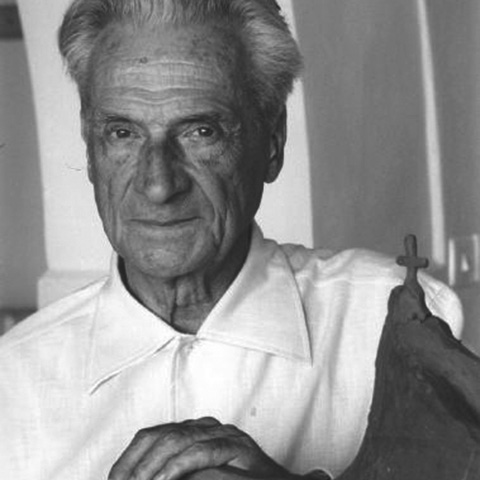
Giovanni Michelucci was born in Pistoia on 2 January 1891 and died on the night of 31 December 1990, two days before his hundredth birthday, in the house-studio in Fiesole that is the seat of the foundation he established.
In his “century-long life” Michelucci had the fortune of crossing the whole twentieth century — the complexity of events, transformations and ideas that animated an era — and he left us precious testimony of it through work always striving to open new languages and proposals. He came from a family that owned a respected workshop for the artisan and artistic working of iron, and the years of his youthful training were steeped in the world of craftsmanship; after graduating from the Higher Institute of Architecture of the Academy of Fine Arts, in 1914 Michelucci obtained his licence as a professor of architectural drawing. He would later teach at the Higher Institute of Architecture in Florence and was elected Dean of the Faculty of Architecture in 1944.
During the First World War Michelucci built his first work of architecture, a chapel on the eastern front at Casale Ladra, near Caporetto: more than once over time he would be forced to confront the effects of catastrophe (the reconstruction of Florence’s centre after the Second World War, the reorganisation of the working-class Santa Croce district after the flood, the church in Longarone after the Vajont tragedy).
After the war he left the “Officine Michelucci”. The Pistoiese artistic milieu — in which he played an important role as an intellectual point of reference — also included Eloisa Pacini, a refined painter whom he married in 1928 and with whom he shared a strong social sensibility. His move to Rome was experienced as an extraordinary opportunity to study the architecture of the sacred city and to undertake new working experiences.
His ability to grasp the relationship with contemporary needs emerged in 1933 when, as coordinator of the Tuscan group made up of Baroni, Berardi, Gamberini, Guarnieri and Lusanna, he won first prize in the competition for the Santa Maria Novella Station in Florence with a work that gained recognised international value not only for its functional qualities but also for the quality of its insertion into the historical and urban context. Intolerant of old and new academies, and far from feeling he belonged to any architectural current or dogmatically bound to a style, in 1935 he built, beside the station, the Palazzina Reale, in which he reaffirmed the value of attention to the history of architecture and the desire to escape the rhetorical excitement with which Rationalism thought it could represent an era.
In December 1945 – January 1946 he founded the magazine “La Nuova Città”. From observing the rubble of Florence’s destroyed centre came, in 1945–46, his reflections and drawings for the reconstruction of the area around Ponte Vecchio; but his innovative ideas for those spaces were dashed against the winning, elitist tendency of rebuilding “as it was, where it was”, which would deliver a series of historical fakes and influence the future commercial museumification of the city. The defeat of his innovative but solitary theses also weighed heavily on Michelucci’s teaching at the Faculty of Architecture, of which he was again Dean from June 1947 to August 1948. In 1948 Michelucci left the Faculty of Architecture in Florence and became a lecturer at the Faculty of Engineering in Bologna, where he remained until the end of his teaching career and where he found an environment more favourable to the development of his themes.
Having painfully left university teaching on reaching the age limit, he devoted himself to rigorous research with which he prepared — alone but not only — a new revolution of his own in the language of architecture: the conception of space as everywhere traversable, the variable city, the rejection of technicist or technocratic formulas and schemes, a new relationship between old and modern expressed also in the combined use of stone and brick with reinforced concrete, steel and the new materials available in architecture.
With the Church of the Motorway and the Church of Borgo Maggiore, in the Republic of San Marino, Michelucci brought his earlier premises to fruition and achieved his design revolution, based on a search for unity between structure and architecture and on the development of space as an architecture of the path. In 1982 Giovanni Michelucci established, together with the Tuscany Region and the municipalities of Fiesole and Pistoia, the “Michelucci Foundation”, whose Director until his death was Guido De Masi, a friend and collaborator of the architect. From an earlier donation of drawings to the Municipality of Pistoia came instead the “Giovanni Michelucci Documentation Centre” in Pistoia.
An enthusiastic and tireless promoter of cultural initiatives and activities even in his final years, he took part with great passion in the fundamental themes of the debate on the city, with nonconformist and always innovative positions.